AI and Soil: The Next Frontier in Preventive Healthcare
Explore 2025’s leading design trends, from emotionally intelligent interfaces to sustainable branding, AI-assisted creativity, and immersive digital experiences that redefine how brands connect, communicate, and captivate in a fast-evolving world.

Naeem Lakhani
Category:
AgriHealth
Date:
March 6, 2024
A Health Revolution Rooted in Soil
Healthcare spending on preventable chronic diseases exceeds €8 trillion every year—and continues to rise. Yet an overlooked truth sits beneath our feet: the health of our soil directly determines the health of our food, our bodies, and our economies.Modern agriculture, optimized for yield instead of nutrient quality, has depleted nearly 40% of the world’s arable land, degraded food nutritional value, and fueled a global chronic disease epidemic. Meanwhile, consumers and food companies face supply chain volatility, input cost spikes, and rising demand for healthier products. The system is breaking down.What’s emerging now is a radically different approach—one that treats agriculture not as an output system, but as a health delivery system. And the breakthrough enabling this shift is AI.
The Digital Inflection Point in Biology
We are at a moment where the cost of AI is falling by nearly 70% per year, computing power is compounding exponentially, and connectivity is reaching even the most remote agricultural landscapes. This convergence is unlocking something unprecedented: the ability to understand biology at scale, in real time, and at the level where nutrition begins—the soil.AI makes it possible to read the “biological code” of soil, plants, and microbes and convert that invisible complexity into actionable intelligence. With the right data and modeling, we can now detect nutrient density, predict toxicity, monitor crop resilience, and validate improvements long before food reaches consumers.This shift marks the transition from reactive symptom management in today’s food-health continuum to proactive, preventive optimization. It challenges the traditional boundaries between agriculture, health, and industry—and opens pathways for entirely new business models.
AgriHealth: A New Category of Preventive Healthcare
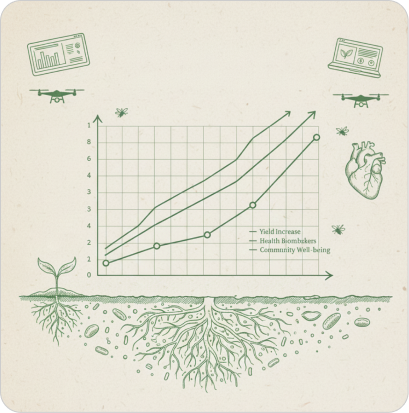
At The First Thirty, we refer to this emerging space as AgriHealth—the intersection where improved soil biology translates into measurable improvements in human health. The food system becomes a scalable health technology, and farmers become frontline healthcare providers, not by changing their profession but by changing their tools.Our research shows that achieving preventive health outcomes through agriculture is 100× more cost-effective than achieving the same outcomes through conventional healthcare systems. Improving soil biology, preventing contamination, and enhancing nutrient density delivers value far beyond the farm gate: better human health, more resilient supply chains, and healthier ecosystems.
How AI Makes AgriHealth Possible
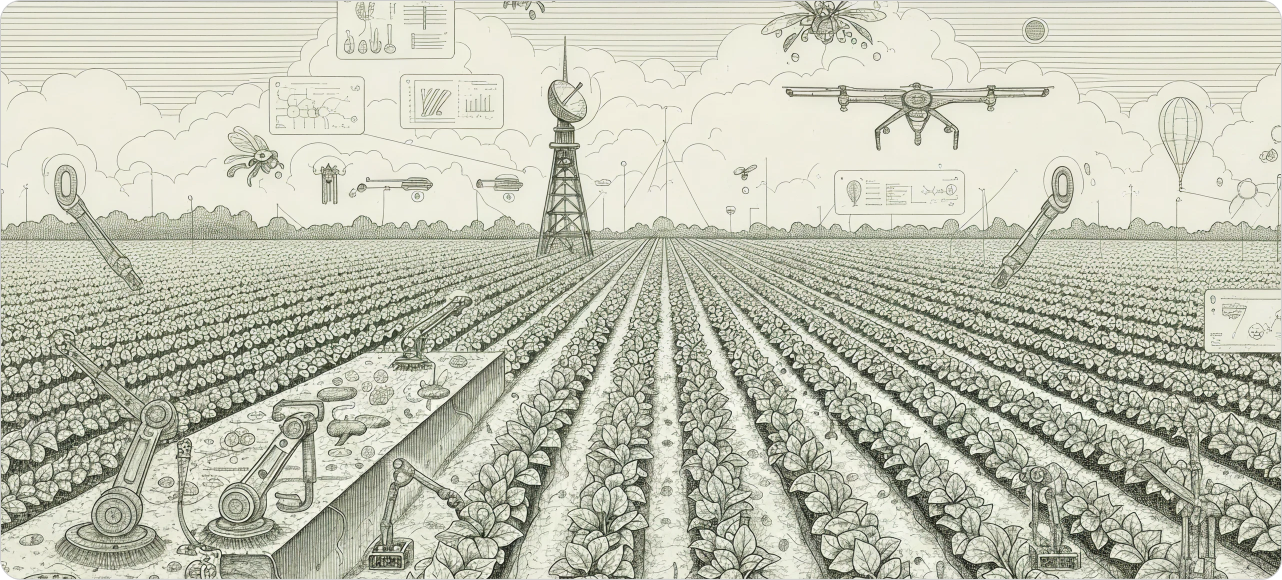
Turning agriculture into preventive healthcare requires four capabilities:
1. Capture Data at the Soil and Crop Level
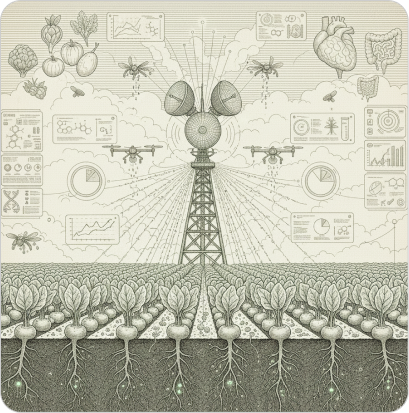
Sensors, spectral imaging, biological assays, and in-field diagnostics generate a real-time understanding of soil function and nutrient flows.
2. Convert Biological Signals into Actionable Insights
AI models analyze complex biological and environmental data to predict nutrient density, toxin risk, and plant resilience.
3. Validate Improvements
Machine learning enables feedback loops that verify whether interventions—microbial inputs, regenerative practices, nutrient strategies—translate into real nutritional gains.
4. Transmit Value Through the Supply Chain
Verified biological improvements become attributes that food companies and consumers can trust, enabling premium, health-differentiated products.
This infrastructure creates venture-scale opportunities hiding in plain sight—where science, data, and market demand converge to form a new category of food and health innovation.
From Soil to Human Outcomes
The first 30 centimeters of soil hold the biological intelligence that determines the nutrient density of our food, the resilience of our crops, and ultimately, the trajectory of public health.
When AI reveals what’s happening in that layer and connects it to decision-makers from farmers to retailers, agriculture becomes the most powerful preventive healthcare platform the world has ever seen.
- The future of health doesn’t begin in a clinic.
- It begins in the soil.
- And AI is the key that finally lets us unlock it.
"The health of soil, planet, animal, and man is one and indivisible."
— Sir Albert Howard